

By Michael Lyjak
Black cats in vintage Halloween material were not confined to greeting cards. Party suppliers could use them to help sell a whole setting: a decorated room, an activity, a table and the paper goods needed to assemble them. Dennison's 1922 Bogie Book is a concrete example. Its cats operate both as things a host could make and as recurring decoration on the catalogue's own pages.
The copy preserved by The Henry Ford is catalogued as a trade catalogue made by Dennison Manufacturing Company in Framingham, Massachusetts. That commercial purpose is central to reading it. These are proposed celebrations, not photographs proving what happened in every home.
A cat face large enough to change a room
On printed page 4, headed Where to Eat, the book suggests transforming a formal dining room with crepe-paper masks, table covers and a large cat face constructed on an umbrella. The cat becomes part of the room's arrangement rather than a small isolated emblem.
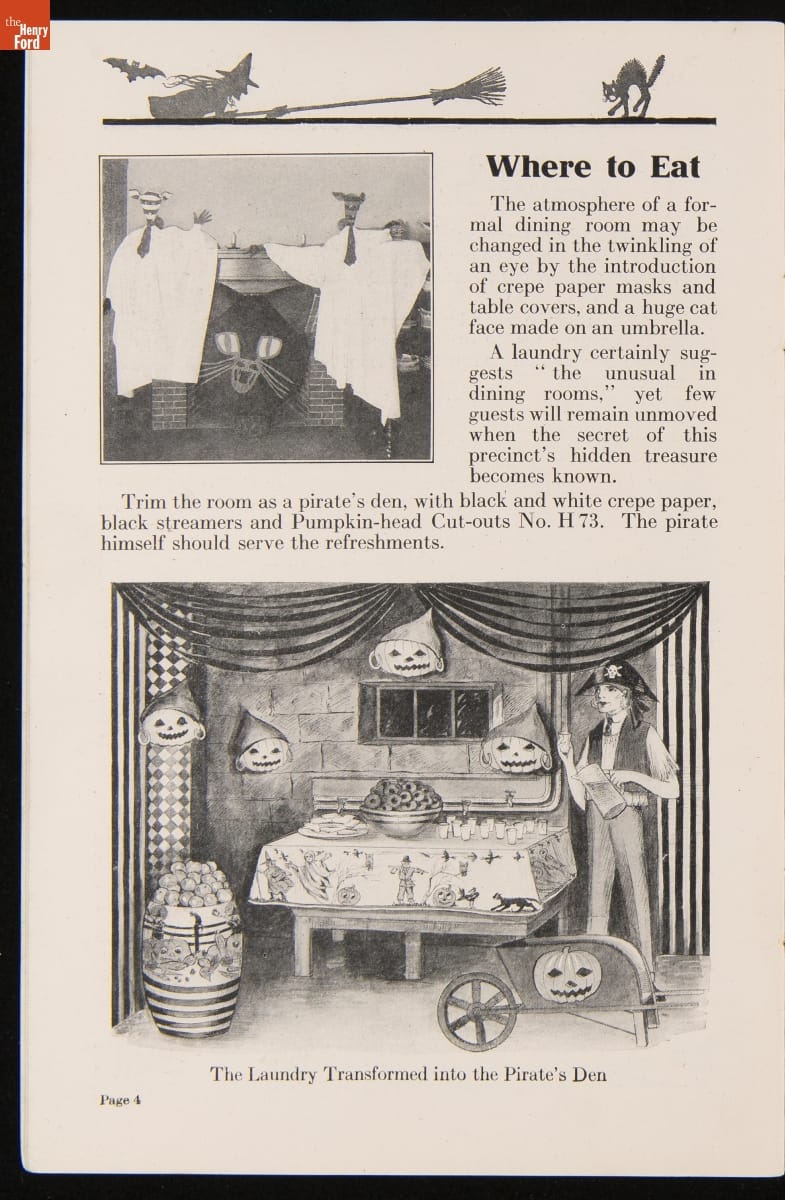
The same page presents a laundry transformed into a pirate's den, with paper streamers and pumpkin-headed cutouts. The pictured refreshment table has cat figures among its decorative motifs.
Those details show how the catalogue joins different seasonal characters into a setting. A host is being invited to imagine an ordinary room temporarily becoming somewhere else. The cat is one ingredient in that transformation, alongside pirates, pumpkins and paper surfaces.
The border carries its own little encounter
Across the top of page 4, a witch faces a bristling cat across a broom. A bat appears behind her. The same header recurs on printed page 20, devoted to matching partners at a dance.
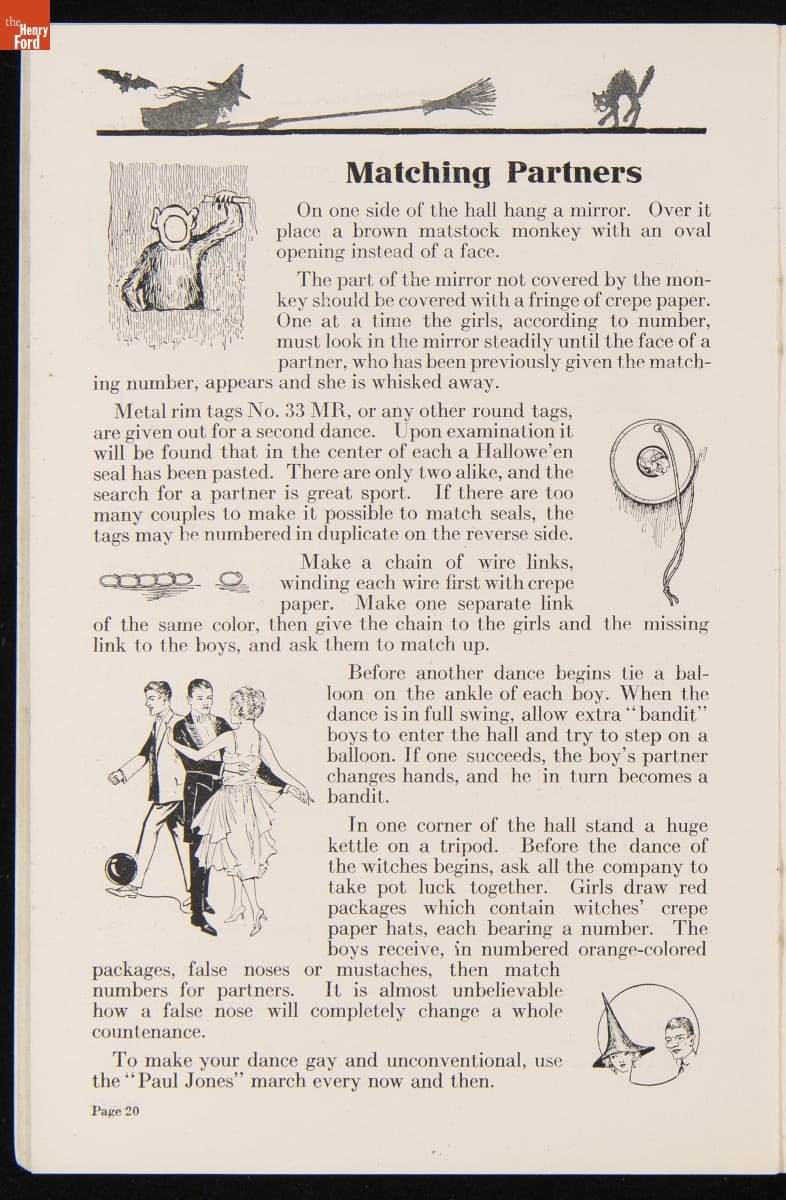
Here the cat is doing a different job. It is not the object the instructions ask a reader to construct. It is part of the booklet's repeated visual frame, keeping Halloween recognizable even when the subject below is a social game.
This distinction is easy to overlook when an old page is shared as a decorative image. The instructional picture, the page border and an advertisement for supplies can all contain cats, but they do not provide the same evidence about how the animal was used.
Instructions connect imagination to stock goods
Page 4 names a numbered pumpkin cutout, while page 20 brings numbered tags and Halloween seals into the arrangements for finding dance partners. Specific supplies sit inside the proposed activities.
The resulting relationship is visible without guessing a company's private strategy. A reader receives an idea and also encounters materials that can help carry it out. This is a historical example of entertainment guidance and commercial promotion occupying the same booklet.
It does not tell us which cat decoration sold best, how much a host spent or whether every suggestion was practical. Those questions would require sales records, accounts or other evidence beyond the illustrated instructions.
A booklet for more than one kind of gathering
The Museum of Witchcraft and Magic describes another surviving Bogie Book as a small paper booklet with a color cover and gray, black and orange illustrations. Its listed sections range from home parties and dinner dances to club or church suppers, games, costumes and Thanksgiving decorations.
The museum interprets the series as helping promote and standardize celebration. That is a useful institutional interpretation, with a limit: the description of this separate copy should not be used to assign an unrecorded date or identical contents to every edition.
What the range does show is that the party booklet could address several settings. The seasonal cat belonged to a practical world of hosts, guests, rooms and things to make, as well as to folklore.
What a commercial cat can establish
Our earlier overview of Halloween black cats separates documented objects from broader origin stories. This catalogue narrows the question further: how could a supplier put a familiar cat image to use?
In the inspected pages, the answers include a large room decoration, a table motif and a repeated header. They document a company's suggestions in 1922. They leave actual adoption and popularity unresolved, while showing how closely a spooky character could be woven into the ordinary business of planning a party.
Featured photograph: a contemporary cat used as contextual illustration, not a historical document, book illustration, film still or named character. Photo by Kristin O Karlsen on Unsplash.
Leave a comment